
In-Situ Testing & Metrology
In-Situ Testing & Metrology
Direct In-Place Subsurface Metrology & Standard Penetration Testing for True Mechanical Soil Parameters
Main Narrative & Technical Overview
Capturing Undisturbed Ground Mechanics in Real-Time
While laboratory testing delivers granular physical properties, certain critical soil behaviors can only be accurately measured in their native, undisturbed stress environment. Sampling disturbances, stress relief, and moisture shifts during core extraction can alter the mechanical response of sensitive ground strata.
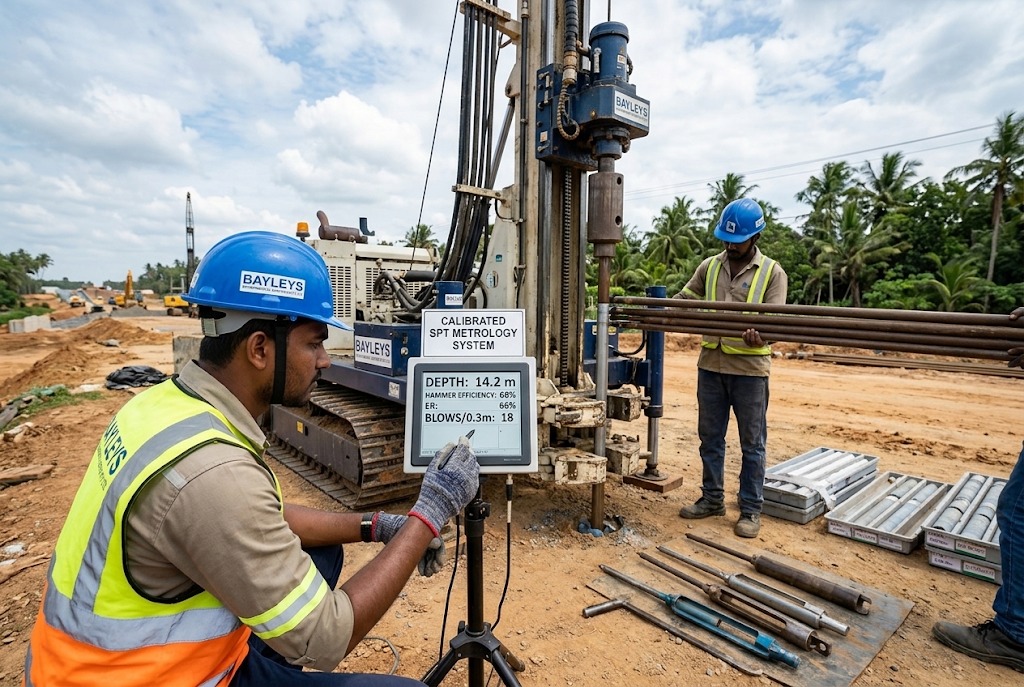
At Bayleys Environmental Services (Pvt) Ltd., our in-situ testing and metrology division captures real-time, in-place geotechnical parameters directly within boreholes and ground surfaces. Utilizing standardized, rigorously calibrated instrumentation, we eliminate operator variability to provide structural engineers with definitive empirical data for foundation load verification, liquefaction potential assessment, and settlement forecasting.
Key In-Situ Testing Capabilities
- Standard Penetration Testing (SPT) with Calibrated Automated Trip Hammers: Standardized dynamic penetration resistance testing executed in strict conformity with ASTM D1586 and BS 5930. Our automated 63.5 kg trip-hammer systems deliver consistent energy ratios (ER) down the drill string, providing true N-values for relative density, undrained shear strength ($c_u$), and allowable bearing pressure computations.
- Field Permeability & Hydrogeological Infiltration Testing: In-situ hydraulic conductivity assessments using falling head, constant head, and Packer testing methods across varying strata depths to quantify groundwater flow dynamics, dewatering requirements, and retention barrier seepage.
- Plate Load Testing (PLT) & Modulus Determination: On-site static load testing on rigid steel bearing plates to determine the Modulus of Subgrade Reaction ($k_s$) and direct ultimate bearing capacity for shallow rafts, road pavements, and industrial floor slabs.
- Field Vane Shear Testing (VST): Direct measurement of undrained shear strength in soft-to-firm saturated cohesive clays and sensitive marine muds, preventing structural shear failures during embankment construction.
- Dynamic Cone Penetrometer (DCP) & Mackintosh Probe Profiling: Rapid, continuous probing to assess subgrade strength, California Bearing Ratio (CBR) correlations, and shallow layer compaction profiles for highway and pipeline alignments.
- Field In-Situ Density & Compaction Metrology: Performing sand replacement and core cutter testing to verify engineered fill compaction percentages against optimum moisture content (OMC) and maximum dry density (MDD) baselines.
Metrological Rigor & International Standards Compliance
Every in-situ measurement executed by Bayleys is governed by strict calibration protocols and traceable instrumentation standards:
- ASTM D1586 / ASTM D6066: Standard Test Methods for Penetration Testing and Energy Measurement.
- BS 1377: Part 9 / BS 5930: Methods for In-Situ Soil Tests and Code of Practice for Ground Investigations.
- EN ISO 22476: Geotechnical Investigation and Testing – Field Testing Protocols.
- SLS & ICTAD Specifications: Full compliance with national highway and building testing standards.
- The Bayleys Advantage in In-Situ Metrology
- Zero Operator Bias: Automatic trip hammers replace manual rope-and-pulley methods, guaranteeing true 760 mm drop height and standardized energy transfer.
- Real-Time Data Digitization: Field logs and SPT blow counts are recorded with instant depth tracking, expediting preliminary report generation.
- Seamless Laboratory Cross-Validation: In-situ metrology data is directly integrated with downstream triaxial, shear, and consolidation lab metrics for verified design confidence.