
Slope Stability Analysis
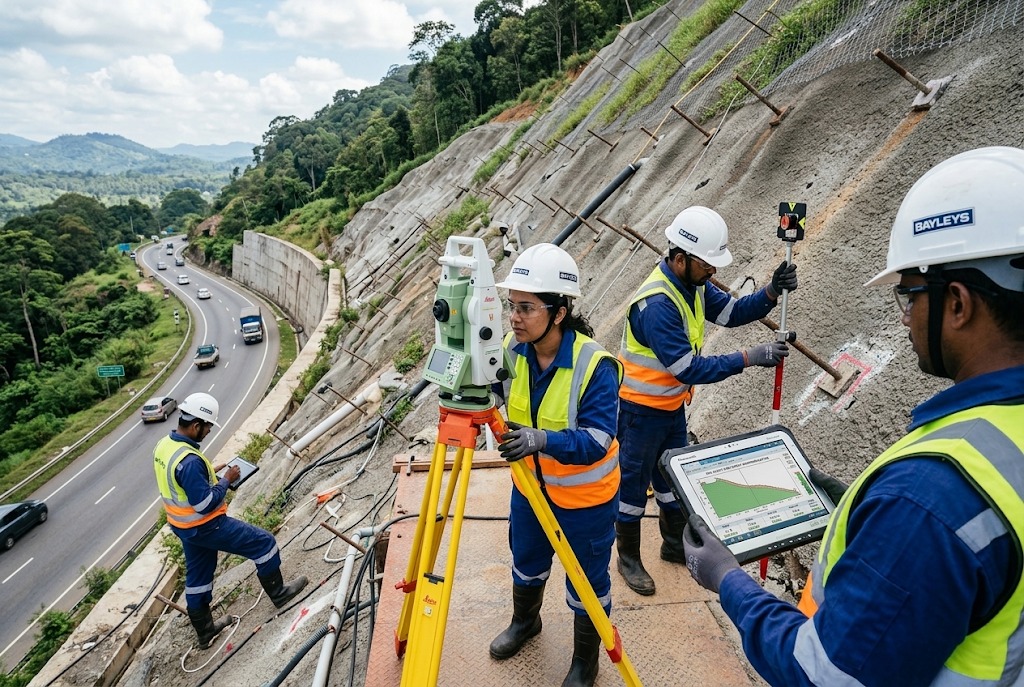
Slope Stability Analysis
Mitigating Landslide Vectors & Safeguarding Critical Terrains Through Advanced Numerical Modeling and Ground Metrology
Main Narrative & Technical Overview
Precision Equilibrium Modeling for Vulnerable Geological Terrains
Slope stability evaluation is a critical geotechnical mandate across highway cut-slopes, hillside developments, deep urban excavations, and earth-retaining systems. Natural geological weathering, unmapped fracture planes, and seasonal groundwater fluctuations can drastically alter soil shear strength, triggering catastrophic slope failure or differential displacement.
At Bayleys Environmental Services (Pvt) Ltd., we bridge physical field metrology with cutting-edge computational mechanics. Our multidisciplinary team performs rigorous multi-scenario numerical simulations to pinpoint potential failure vectors, compute critical factors of safety, and engineer robust slope stabilization and earth retention systems.
Key Slope Stability Capabilities
- Limit Equilibrium Method (LEM) Factor of Safety Analysis: Computing critical Factor of Safety (FoS) indices across thousands of potential circular and non-circular slip surfaces using established rigorous formulations (Bishop, Janbu, Morgenstern-Price, and Spencer methods).
- Finite Element Method (FEM) Stress–Deformation Modeling: Simulating plastic deformation vectors, internal strain localization, and progressive shear band formation to assess exact slope displacements under static and seismic conditions.
- Transient Hydrogeological & Seepage Simulation: Modeling the destabilizing impacts of intense tropical monsoon rainfall, rising phreatic water levels, and internal pore-water pressure spikes on slope equilibrium.
- Deep Excavation & Shoring System Design: Evaluating lateral earth pressure distributions and deflections for deep basement excavations supported by sheet piles, soldier piles, secant piles, or contiguous pile walls with multi-tier tieback ground anchors.
- Engineered Slope Stabilization & Ground Support Schemes: Developing comprehensive, cost-optimized mitigation blueprints including soil nailing arrays, prestressed rock bolts, reinforced shotcreting, drainage galleries, and Mechanically Stabilized Earth (MSE) retaining structures.
Engineering Compliance & Design Standards
All stability assessments and retaining design recommendations strictly adhere to established international and local engineering design codes:
- Eurocode 7 (BS EN 1997-1): Geotechnical Design & Limit State Verification.
- BS 8006: Code of Practice for Strengthened/Reinforced Soils and Other Fills.
- ASTM & SLS Standards: In-situ shear strength and material classification baselines.
The Bayleys Advantage in Slope Engineering
- Direct Field-to-Model Calibration: Simulation inputs are directly derived from our calibrated in-situ SPT metrology, undisturbed triaxial testing, and rock core RQD logs rather than generic theoretical assumptions.
- Optimized Cost Engineering: Tailored stabilization recommendations prevent structural over-design while ensuring strict statutory safety factors.
- Actionable Structural Blueprinting: Clear, constructible mitigation drawings and step-by-step installation sequences for civil contractors and project engineers.